What Bay Air Does to a Viking Near the Waterfront
| This guide | Fault Guides |
|---|---|
| Appliance | Viking Range Repair |
| Written by | Hollis Yamada |
| Role | Service technician — refrigeration and cooking |
| In the trade | 21 years in the trade |
| Reading time | 5 min |
| If it needs a visit | $89, credited to the repair |
Air off Commencement Bay carries salt, and the chloride in salt is the usual trigger for spots on stainless steel. Near the water that mostly shows as marks on a Viking's front, which is cosmetic. How to clean them without making things worse, what is not cosmetic, and when it needs a visit.
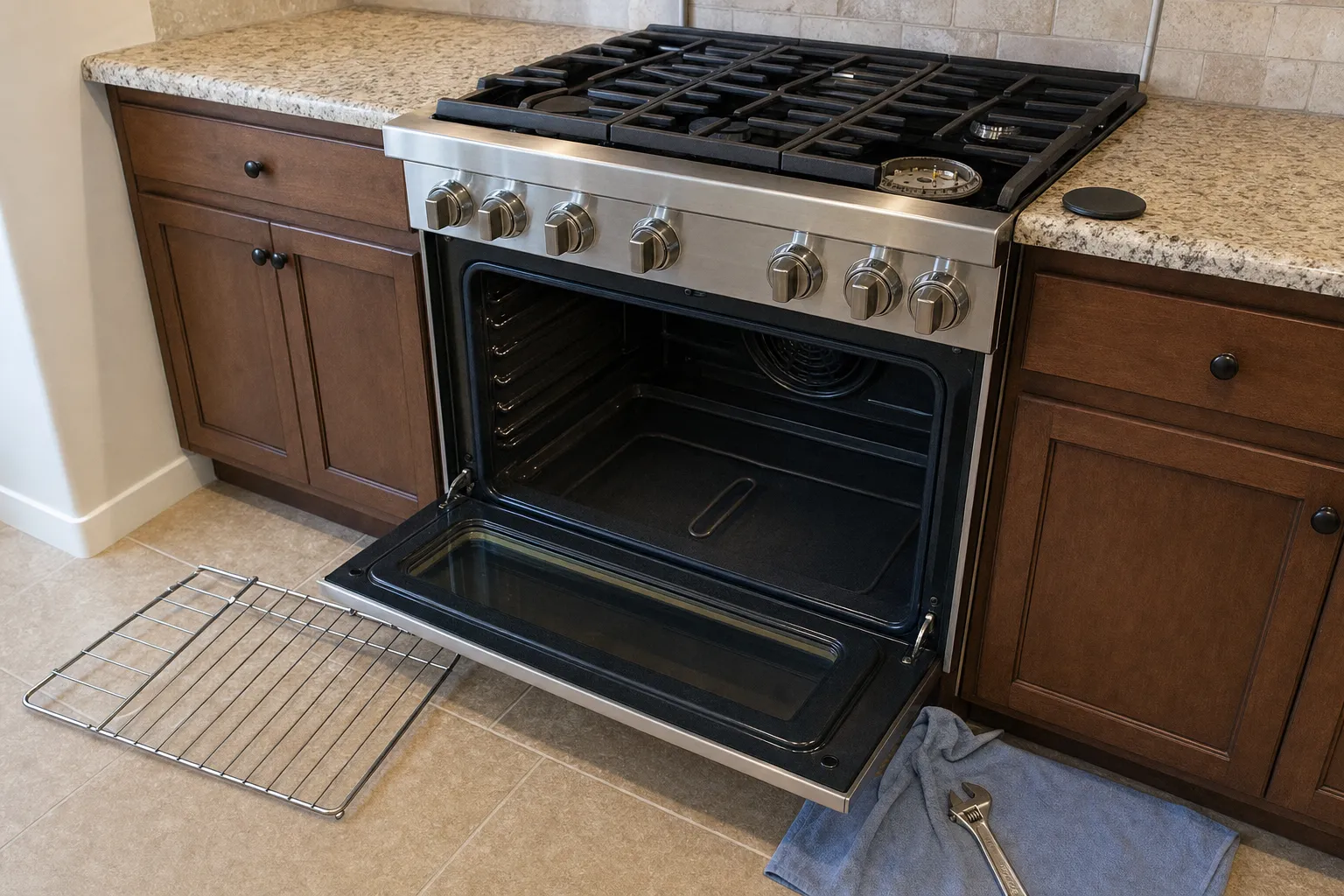
Some Viking kitchens in this city sit close enough to Commencement Bay to smell it: along the Ruston Way waterfront, down the slope in Old Town, in the buildings at Point Ruston, and out along the shore at Browns Point and Dash Point. Owners there tend to ask the same thing once they spot small brown marks on a range front. Is the bay eating the appliance?
Mostly, no. What salt air does to a kitchen Viking is largely a matter of looks. This guide sorts the cosmetic from the mechanical.
Why stainless spots near the water
Stainless steel is not stainless in the literal sense. Viking’s own care notes put it plainly: it stains and rusts far less readily than ordinary steel, but it is not proof against either. The chromium in the alloy forms a thin, invisible oxide film on the surface, and that film, rather than the metal under it, does the protecting. Scratch it or leave contaminants sitting on it, and the surface can discolour, stain or corrode.
Chloride is the usual trigger. It attacks that film in small, local spots instead of evenly, and sea air carries it. The same Viking document names coastal sites, where stainless meets halide salts such as sodium chloride, as the places routine cleaning counts most. It was written for Viking’s outdoor refrigerator; an indoor range sees far less salt, but the chemistry is the same on the kitchen side of the window.
The brown marks have a trade name: tea staining. The Australian Stainless Steel Development Association describes it as discolouration by corrosion that is cosmetic and leaves the steel’s strength alone. It gets worse the closer you are to the sea, and it favours surfaces that rain never washes. Indoors, nothing is rain-washed, so the cloth does the rain’s job.
The kitchen adds chloride of its own: salted water boiling over, brine off a pan, a bleach wipe used on the worktop and then on the oven door.
Cleaning that helps, and cleaning that harms
| Surface | Clean with | Keep away |
|---|---|---|
| Stainless fronts and doors | Warm water, mild detergent, soft cloth; rinse, dry | Steel wool, scouring powder, bleach |
| Control panel and knobs | Hot soapy water, soft cloth | Ammonia, abrasives |
| Burner caps | Warm soapy water; dry thoroughly | Dishwasher, self-clean oven |
| Refrigerator door gaskets | Mild detergent, warm water | Chlorine bleach, cleaning waxes |
The first row does most of the work. Wipe along the polish lines of the steel, never across them; the stainless association warns that rubbing against the grain spoils the finish, and Viking’s coastal notes ask for the same direction. Rinse, then dry with a soft cloth. For stubborn marks use a liquid cleaner made for stainless, but read the label: Viking warns that some products sold under that name contain abrasives, or chlorine bleach that discolours the steel if any is left behind.
Steel wool earns its own warning. It is usually plain carbon steel, and the fragments it sheds rust where they lie, leaving orange specks the bay then gets blamed for. Viking’s range manual adds that citrus or tomato juice left on stainless discolours it for good.
The second row protects the printing. Viking asks owners to keep ammonia and abrasive cleaners off the control panel and knobs, because they can lift the graphics.
The third row matters more than it looks. Viking’s range manual asks for burner caps to be dried thoroughly after washing and kept out of the dishwasher and the self-cleaning oven, partly to avoid rust. A cap put back wet can also leave a burner ticking after it lights.
The fourth row is the refrigerator. Viking’s guide for its 7 Series integrated columns rules out chlorine bleach, cleaning waxes and concentrated detergents on the door gaskets.
Viking’s coastal notes also say where to look: seams, crevices, the folds under gaskets and the heads of fasteners, anywhere a little liquid can sit and concentrate what it carries.
What is not cosmetic
A burner that ticks after it lights. Viking’s troubleshooting table lists wet or dirty igniters among the causes of sparking that carries on once the flame is up. In a waterfront kitchen the damp usually comes from the pot or the cloth rather than the air, and a burner base left to dry fully, cap off, clears most of it. One that still ticks the next day is worth a visit.
A flame that turns yellow. Viking puts a large, distorted or yellow flame down to clogged burner ports, the wrong gas for the range, or air shutters out of adjustment. Salt is not on that list, so check the ports and the cap before blaming the bay. Clearing a blocked port with a straight pin, without enlarging it, is a job Viking’s manual gives the owner; the gas and air settings are not.
Corrosion on hardware. Rust that keeps coming back on a screw head, a hinge or a bracket is not a cleaning problem, and Viking’s coastal advice is to replace corroding hardware rather than live with it. Mention it when you book.
A refrigerator that runs without a break. A built-in refrigerator draws room air across its condenser coil, and a coil clogged with lint and dust makes the unit work harder, by the water or anywhere else. How often it needs cleaning depends on the model. Viking’s guide for its 7 Series integrated columns asks for every six months, and promptly after building work nearby; its 5 Series side-by-side models use a pin-and-tube condenser that Viking calls maintenance-free under normal operation. On the columns the coil sits behind the kick plate, so that job belongs to the visit rather than to you.
When it needs a visit
Book a visit when a burner still ticks after a full day to dry, when a flame stays yellow with the cap seated and the ports clear, when rust keeps returning to the hardware, or when a refrigerator runs on and on without holding its temperature. The $89 visit is credited to the repair once you approve it. Burner work sits in the igniter or burner assembly band, the usual refrigeration faults in the refrigeration fan or defrost system band, and you hear the figure before anything is fitted.
Asked after reading this
Is tea staining on a range front a sign the steel is failing?
No. The Australian Stainless Steel Development Association treats tea staining as cosmetic: it leaves the strength and working life of the steel alone. It comes off with warm water, a mild detergent and a soft cloth worked along the grain, then a rinse and a dry. Marks that keep returning only mean cleaning more often near the water.
Can I use a bleach wipe on the stainless if I rinse it straight after?
Better not. Bleach is on the stainless industry's list of cleaners to avoid, and Viking notes that cleaners containing chlorine bleach dull, tarnish or discolour the steel if any is left behind. On the fronts, warm water with a mild detergent does the job. Keep the bleach for surfaces in the kitchen that are not stainless.
Does living on the water mean a Viking will need more repairs?
We have no figures that would show it, and we will not invent any. What the bay changes is how often the stainless wants cleaning. Burners that tick and refrigerators that run warm happen on the shore and inland alike. For those, Viking Repair Tacoma is on (206) 472-1140, $89 credited.