Igniter Keeps Clicking After the Burner Is Lit
| Reading | Likely cause | Owner check | Price band |
|---|---|---|---|
| Ticks on after lighting, often after a boil-over or a wipe-down | Damp in the burner base, or the cap sitting off its seat | Burner off and cool; reseat the cap flat; leave the cap off to dry | $180–$440Igniter or burner assembly |
| One burner only, its flame small or ragged at the electrode | Ports near the electrode clogged with spill, or a cracked electrode | Look for burnt-on spill in the ports and a crack in the white ceramic | $180–$440Igniter or burner assembly |
| Ticks with every knob turned off | A worn switch behind one knob, or the spark module | Nothing to try at the knob; switch the range off at the breaker | Quoted after the diagnosis |
| Every lit burner ticks on, dry or not, in an older rewired house | The range's supply not grounded, or its polarity reversed | Nothing to try at the range; tell us when the kitchen was rewired | Work for an electrician; no price of ours |
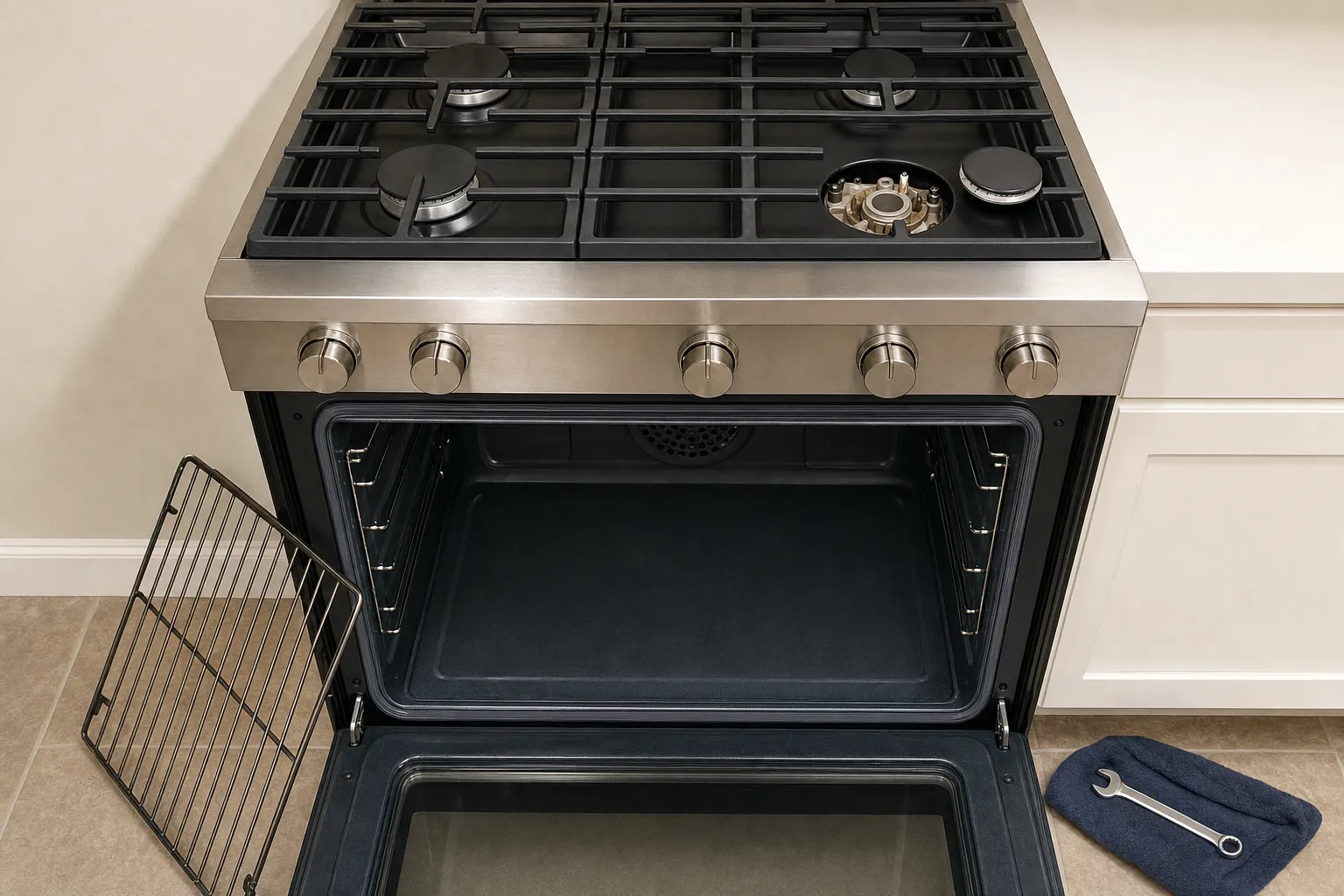
The flame is up and the ticking will not stop. Usually damp or a cap off its seat; now and then a cracked electrode, a switch, the spark module or the house wiring.
Damp, a cap off its seat, or something electrical
Row one is the common one. A burner that keeps ticking once the flame is up has usually been boiled over, wiped with a wet cloth or sprayed, and water around the electrode gives the spark an easier path than the gap it is meant to jump. A cap set down off its seat does much the same. Neither needs a part, and the checks below cover both.
Row two is the fault that did not clear once dry: burnt-on spill in the ports beside the electrode, or a hairline crack in its ceramic. That takes a visit, and the answer is usually a single electrode rather than a whole burner.
Row three is not a burner problem. Ticking with every knob off comes from a switch behind one knob, or the spark module, telling the range a burner wants lighting. No owner fix, no published band: it is priced once the part is found.
Row four is the Tacoma row. Viking’s troubleshooting table names a supply that is not grounded, or one wired with its polarity reversed, among the causes of sparking that carries on after ignition. On the North Slope and in the older streets of the North End, the circuit behind a pro-style range arrived with a later remodel, so it is ruled out before an electrode is blamed. The wiring itself is an electrician’s job.
Owner checks, in this order
- Turn the knob off and wait until the grate and cap are cool, then lift the cap and set it back so it sits flat and does not rock.
- If the ticking began after a spill or a wet wipe-down, leave the cap off and let the burner base air-dry for a few hours before lighting it again.
- Shine a flashlight on the electrode's ceramic sleeve. A visible crack, or black carbon caked on it, is worth mentioning when you call.
- If it ticks with every knob off and will not stop, switch the range off at its breaker and leave it off until the visit.
- Stop there. Anything past these checks means panels off or gas and wiring, and that is the $89 visit from Viking Repair Tacoma: (206) 472-1140.
Asked about this one
Does the ticking mean gas is leaking?
No. The ticking is electrical: a spark jumping from the electrode to the burner. If the flame is lit and steady, the gas is burning as it should. What matters is gas that flows without catching. If the kitchen ever smells of gas, get everyone outside first and ring the gas company or 911 from the street.
What does the visit cost if a part is needed?
The visit is $89 and comes off the repair. If an electrode or other burner part has to be replaced, the figure sits inside the igniter and burner band shown in the table, and you hear it before anything is fitted. Viking Repair Tacoma books visits on (206) 472-1140.