Is There Even a Gas Meter? Buying and Servicing a Viking Range in an All-Electric Tacoma Kitchen
| This guide | Fault Guides |
|---|---|
| Appliance | Viking Range Repair |
| Written by | Hollis Yamada |
| Role | Service technician — refrigeration and cooking |
| In the trade | 21 years in the trade |
| Reading time | 4 min |
| If it needs a visit | $89, credited to the repair |
Before buying a Viking gas range in Tacoma, check whether the house has a gas meter at all. Cheap municipal hydro power and widespread electric heating mean many older North End, Proctor and Stadium houses were never plumbed for gas in the first place.
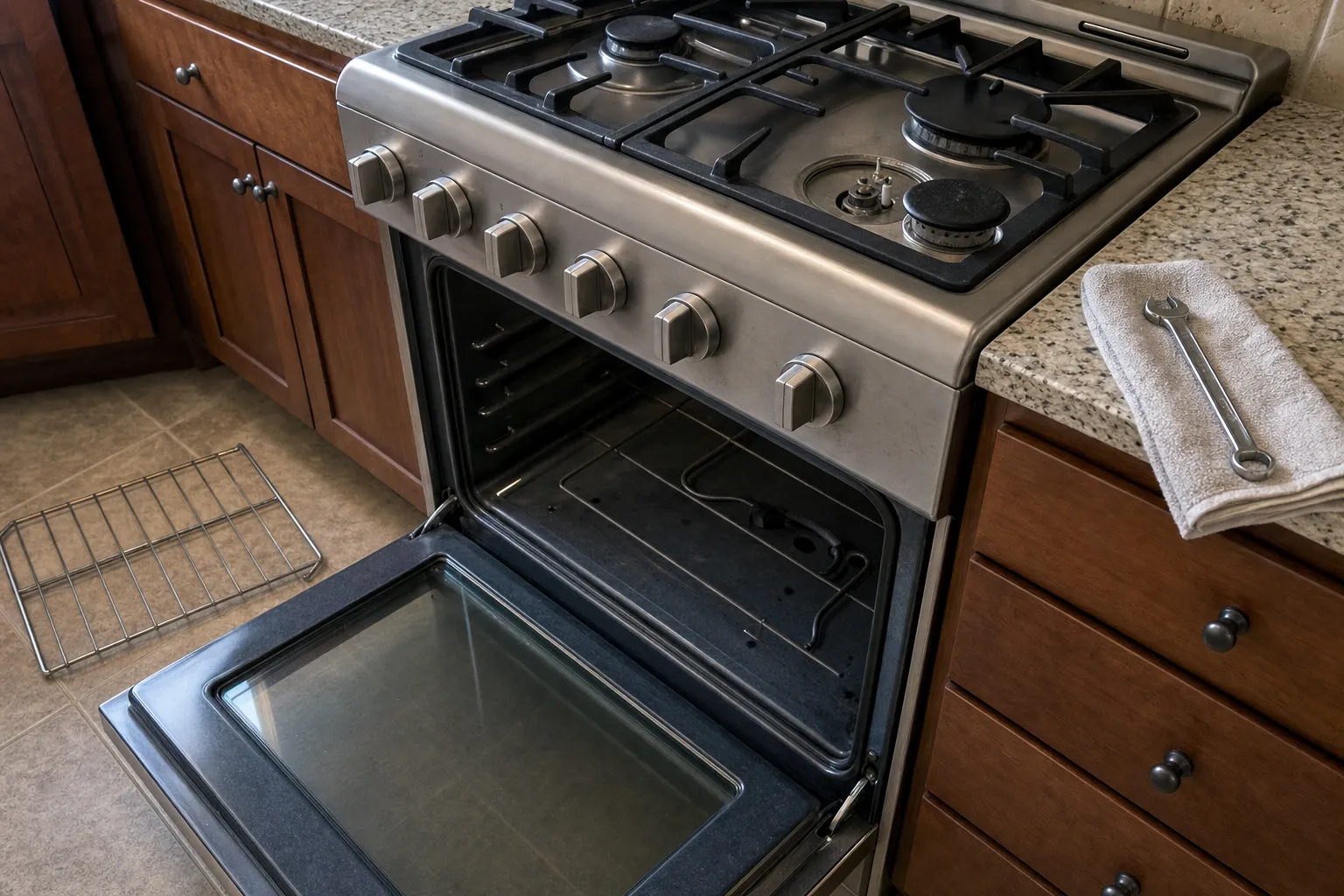
Everywhere else, the pre-purchase question about a professional gas range is how big the pipe is. Here it comes one step earlier: go outside and see whether the house has a gas meter at all. In a cheap-hydro city inside the most electrically heated corner of the country, a surprising number of Tacoma kitchens have never had a gas line, and nobody discovers it until the range is on a truck.
What Tacoma actually does differently
Tacoma Power is the city’s own utility, and most of what it supplies comes from hydroelectric dams, so household electricity here has long been cheap by national standards. Washington also leans on electric heat more than most states do. Neither fact needs a precise figure to make its point, and this article will not pretend to one. What they explain is a habit. When electricity is that cheap and heating is already electric, there was never much reason to run gas to a house — so a great many older North End, Proctor District and Stadium District homes were simply never plumbed for it.
There is no reliable published figure for how many Tacoma houses have gas service, and this article is not going to invent one. Go and look for the meter.
How that reaches the appliance
A Viking pro-style gas range needs three things the house must already have or be given: a gas supply of the right size and pressure at the right place, an electrical supply for ignition and controls, and ventilation. The first of those is not a small retrofit if it is absent. Bringing gas to a house that has none means a service connection from the utility, a meter, and a run of pipe through a building that has no route prepared for it — a project with a permit and a trench, not an afternoon.
The alternative is not a downgrade. Viking builds electric and induction cooking equipment, and in an all-electric house the sane move is often to buy into the fuel the building already has rather than to reconstruct the building around the appliance. That decision then changes what breaks later: an all-electric kitchen never generates an ignition or gas-valve call, and instead generates element, control and induction-board calls.
Northeast Tacoma is the counterweight. Newer builds up on the ridge frequently went in with gas from the start and often carry a full Viking suite, so up there the pre-purchase question really is about pipe and pressure rather than about existence.
What tends to give first
On the gas side of the split, the classic complaints are ignition and flame quality: a front burner that clicks and clicks without catching, one burner burning yellow and sooty while its neighbours are blue, a simmer burner that will not hold a low flame, or a griddle plate hot at one end and cold at the other. Those are spark module, electrode, burner cap seating, orifice and valve issues — with the caveat that a range converted between natural gas and propane by someone in a hurry produces the same symptoms and needs the conversion checked before parts get replaced.
On the electric side, the failures cluster around elements, sensors, relays and boards, and they present as heat that never arrives or never stops rather than as flame that misbehaves. Both sets of faults are ordinary. What is not ordinary is a gas range that has been retro-fitted into a house on an improvised supply, which produces intermittent, load-dependent nonsense that looks like six different faults at once.
What you can check yourself
Before you buy, walk the outside of the house and look for a gas meter — usually on a side or rear wall, sometimes in a recess near the utility entrance. Then look behind the existing range for a capped stub or a shutoff valve. Then look at the receptacle: a large multi-pin range outlet means the kitchen is set up for an electric range, while a standard outlet behind a gas appliance is only powering ignition and controls.
If you already own the range, the useful self-checks are small. Confirm which burners misbehave and whether it changes when others are lit. Clean and reseat the burner caps and check they sit flat, since a cap slightly out of position is a genuinely common cause of a yellow, lazy flame. Make sure the igniter ports are dry and free of spill. Beyond that, stop: gas valves, orifices and conversion kits are not homeowner territory, and a smell of gas means everyone out of the house before anyone rings the gas company or 911.
What a visit settles
The visit answers the question the paperwork cannot: what this specific kitchen actually has, and whether the appliance in it is being fed properly. On a gas range that means checking supply and combustion behaviour under load, verifying the conversion state matches the fuel, and testing ignition components as components rather than by swapping them. On an electric or induction range it means measuring the supply and reading the control’s own diagnostics.
The visit is $89 and comes off the repair once you approve it; what the repair itself falls in is on the price table, band by band, rather than repeated here. Viking Repair Tacoma books on (206) 472-1140, or through the booking page.
Asked after reading this
How can I tell whether my house has gas before buying a range?
Walk the perimeter and look for a meter, usually on a side or rear wall near the utility entrance. Then look behind the current range for a capped stub or a shutoff valve. A large multi-pin receptacle back there means the kitchen was set up electric. No meter and no stub means budgeting for a service connection before the appliance.
Is an induction Viking a compromise in an all-electric Proctor house?
Not really. Where a house has never had gas, buying into the fuel the building already carries avoids a utility connection, a meter and a pipe run through finished rooms. It also changes what fails later: no ignition or gas-valve calls, and element, sensor and control work instead. Ventilation requirements are generally lighter too.
My burner burns yellow after a recent move. What causes that?
Two things, commonly. A burner cap knocked out of position sits proud of its seat and burns lazy and yellow, so reseating it comes before anything else. The other is a range converted between natural gas and propane that was never fully set up for the fuel it now runs on. Both are checkable, and neither is cured by a new igniter.