Old-House Wiring and a Dual-Fuel Viking Range in North Tacoma
| This guide | Fault Guides |
|---|---|
| Appliance | Viking Oven Repair |
| Written by | Hollis Yamada |
| Role | Service technician — refrigeration and cooking |
| In the trade | 21 years in the trade |
| Reading time | 6 min |
| If it needs a visit | $89, credited to the repair |
A dual-fuel Viking lights its burners on gas and heats its oven with electric elements, all fed through one heavy connection at the back. In a North Tacoma house wired long before ranges like it existed, that supply deserves an early look. What you can check, and what belongs to an electrician.
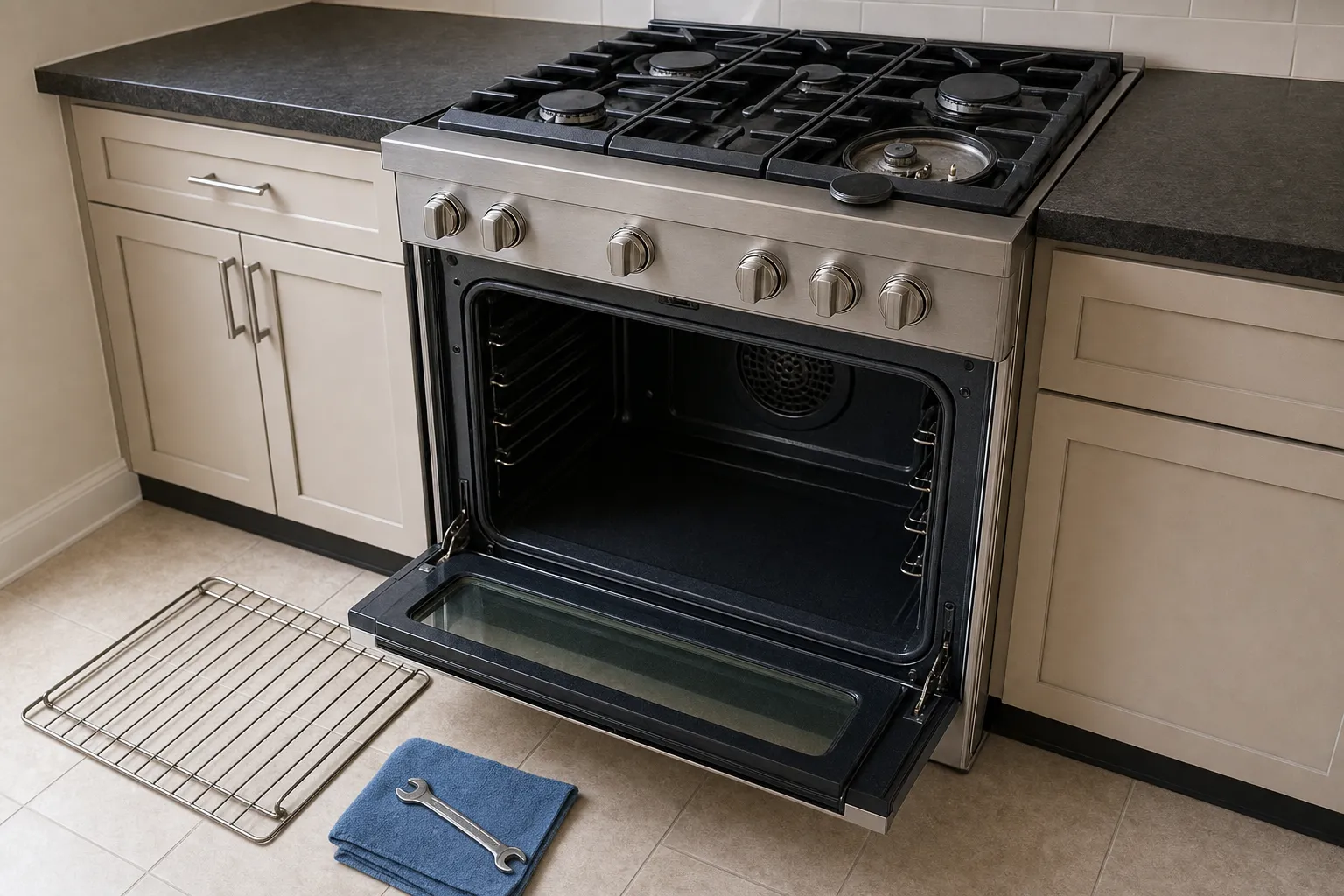
Most houses on the North Slope, and plenty more across the North End, were built long before anyone cooked on a pro-style range. The Viking came decades later, into a kitchen remodelled more than once, and a dual-fuel model brought a demand the original builders never planned for: a heavy electrical supply behind the range.
This guide covers that supply: the signs that point past the range to the wiring, what you can safely look at, and where our work stops and an electrician’s starts. For a kitchen with no gas at all, see our companion guide on checking for a gas meter.
Two fuels, one electrical connection
A dual-fuel range divides the cooking. The burners on top burn gas; the oven below heats with electric elements. What catches people out is that everything electrical on the range, from the oven elements to the controls, the lights and the burners’ spark igniters, comes in through a single connection.
Viking’s installation guide for its Tuscany dual-fuel ranges shows how it is made: a power-supply cord kit, or wiring in conduit, fixed to a terminal block at the rear of the range under a small cover. The guide lists the supply as 120/240 or 120/208 volts. The current rating varies between models, and yours is in its own installation guide.
Two things follow. A tripped range breaker takes the spark from the burners as well as the heat from the oven, so a range that goes quiet on top and cold below at the same moment is pointing at its supply first. And because the elements draw nearly all of the current, trouble in the supply usually shows in the oven.
Viking’s manual for its 3 Series dual-fuel range says preheat time depends in part on the power supply, and that a supply under 240 volts makes it longer. It adds that a brown-out may or may not upset the range, depending on how deep it goes, and that in a power cut the igniters do nothing and the range should not be used.
What a century-old house brings to it
The Slope’s historic district is listed on the National Register, and it is among the biggest in Washington; most of its houses were already standing before the Depression. Houses of that age were typically first wired with knob-and-tube, which stayed in common use in North American homes until around the middle of the last century. It carries no grounding conductor, and it was laid out with fewer circuits than a kitchen asks for now.
None of that tells you what is inside your walls today. Many of these houses have been rewired in part or in full, and a historic listing covers the streetscape, not the cable runs. What the age does tell you is that the circuit feeding your range is unlikely to be original, and may have been joined onto older work along the way.
Three things about that circuit matter to a dual-fuel Viking:
- Its size. A circuit put in for an earlier, smaller range can be lighter than the one your Viking’s installation guide asks for.
- How it is grounded. The Tuscany guide allows a three-wire connection, with the neutral tied to the range cabinet, only where local code permits grounding through the neutral; otherwise it calls for four wires. Which one your kitchen needs is a question for an electrician.
- Its joins. Every splice between the panel and the range is a place where a loose or tired connection can run hot under the oven’s load.
Wiring can reach the burners too. Viking’s troubleshooting table lists a supply that is not grounded, and one with its polarity reversed, among the reasons igniters keep sparking after the flame is lit, alongside igniters that are simply wet or dirty.
Signs that point behind the range
| What you notice | What it can mean | Whose job |
|---|---|---|
| Oven slow to preheat, burners fine | Low supply voltage, or a weak element | Ours to test first |
| Breaker trips as the oven heats | A strained circuit or join, or a shorted element | Reset once, then call |
| Burners silent and oven dead together | The range breaker is off | Look at the panel |
| Ticking carries on after the flame lights | Damp igniters, or an ungrounded or reversed supply | Dry it, then call |
| Hot or burning smell behind the range | A connection overheating | Breaker off, electrician |
The first line: since Viking names the supply as one of the things preheat depends on, a slow oven in an old house is not automatically a failing element, nor automatically the wiring. Viking also says its convection preheat is meant to run slightly longer than bake, so compare like with like first.
The second line gets one reset and no more. Note what was running when it went: the oven mode, whether self-clean was on, what else in the kitchen was drawing power. If it trips again, leave it off; resetting it over and over only keeps loading whatever made it trip.
The third line is the quickest to settle. Find the range’s breaker before you suspect the range. Viking’s own table sends a range that will not work at all to an electrician to check the breaker, wiring and fuses.
The fourth line is usually damp from a boil-over or a wet cloth. Lift the cap, let the burner base dry and try again later; if it still ticks, the wiring causes on Viking’s list are among the things the visit checks.
The last line is not a diagnosis to make yourself. Switch the range off at its breaker, keep it off, and get an electrician in first.
What you can check, and what you leave alone
- The range’s breaker at the panel, reset once. In a house still on fuses, leave the range fuse to an electrician.
- Whether lights or other appliances misbehaved at the same moment, which can point at the house supply rather than the range.
- The burner caps, seated flat, and the burner bases, dry.
Leave the rest alone. Do not pull the range out to reach the outlet or the cover at the back, do not open the panel, and do not move the range onto another circuit or an adapter. Everything behind the range and inside the panel is live wiring.
Where our visit ends and an electrician’s work begins
The visit treats the range as the suspect until it is cleared. The technician tests the oven elements and controls, checks the igniters and the wiring inside the range, and measures what the supply actually delivers at the range. That measurement is what tells a tired element from a tired circuit.
A fault inside the range is priced the usual way: an element in the oven thermostat or heating element band, a control fault in the control board or touch panel band, a burner part in the igniter or burner assembly band. The $89 visit comes off the repair once you approve it.
If the range is sound and the supply is not, we say so and stop there. We do not run circuits, change breakers or work inside the panel; that is an electrician’s work, and you leave knowing what to ask them. The gas pipe and valve are a gas fitter’s, and any smell of gas means everyone outside, then the gas company or 911 from the street.
Asked after reading this
Why does my dual-fuel Viking take longer to preheat than the oven we had before?
Several reasons can stack up. Viking's manuals say a supply below 240 volts or a cold room lengthens preheat, and convection preheat runs a little longer than plain bake by design. An element that is wearing out gives the same complaint. Measuring the supply at the range and testing each element separates those causes in a single visit.
Can the range go on another outlet while the circuit is being sorted out?
No. A dual-fuel Viking takes its power through a cord kit or conduit made up at its own terminal block and rated for the range, so a kitchen outlet, an adapter or an extension lead is no stopgap. Leave the range off at its breaker until an electrician has put the supply right, then have the range itself checked.
Who should I call first, Viking Repair Tacoma or an electrician?
If nothing smells hot, start with the range. Viking Repair Tacoma tests the elements, controls and igniters and measures what the supply delivers, for $89 credited to any repair, on (206) 472-1140. If the fault turns out to be in the wall or the panel, you hear that plainly and take it to an electrician with a clear brief.