One Burner Yellow and Sooty, the Rest Blue
| Reading | Likely cause | Owner check | Price band |
|---|---|---|---|
| Yellow since the last boil-over or wipe-down | Cap not sitting level on its burner, or damp trapped under it | Burner cold: lift the cap, dry both parts, set it back flat | Quoted after the diagnosis |
| Yellow, with gaps or stubby flames round the ring | Ports along the ring closed by burnt-on spill | Open each blocked port with a straight pin | Quoted after the diagnosis |
| Still yellow after a thorough clean and reseat | Too little air reaching that burner: its shutter or orifice | Nothing to adjust yourself; note whether pans soot up | Quoted after the diagnosis |
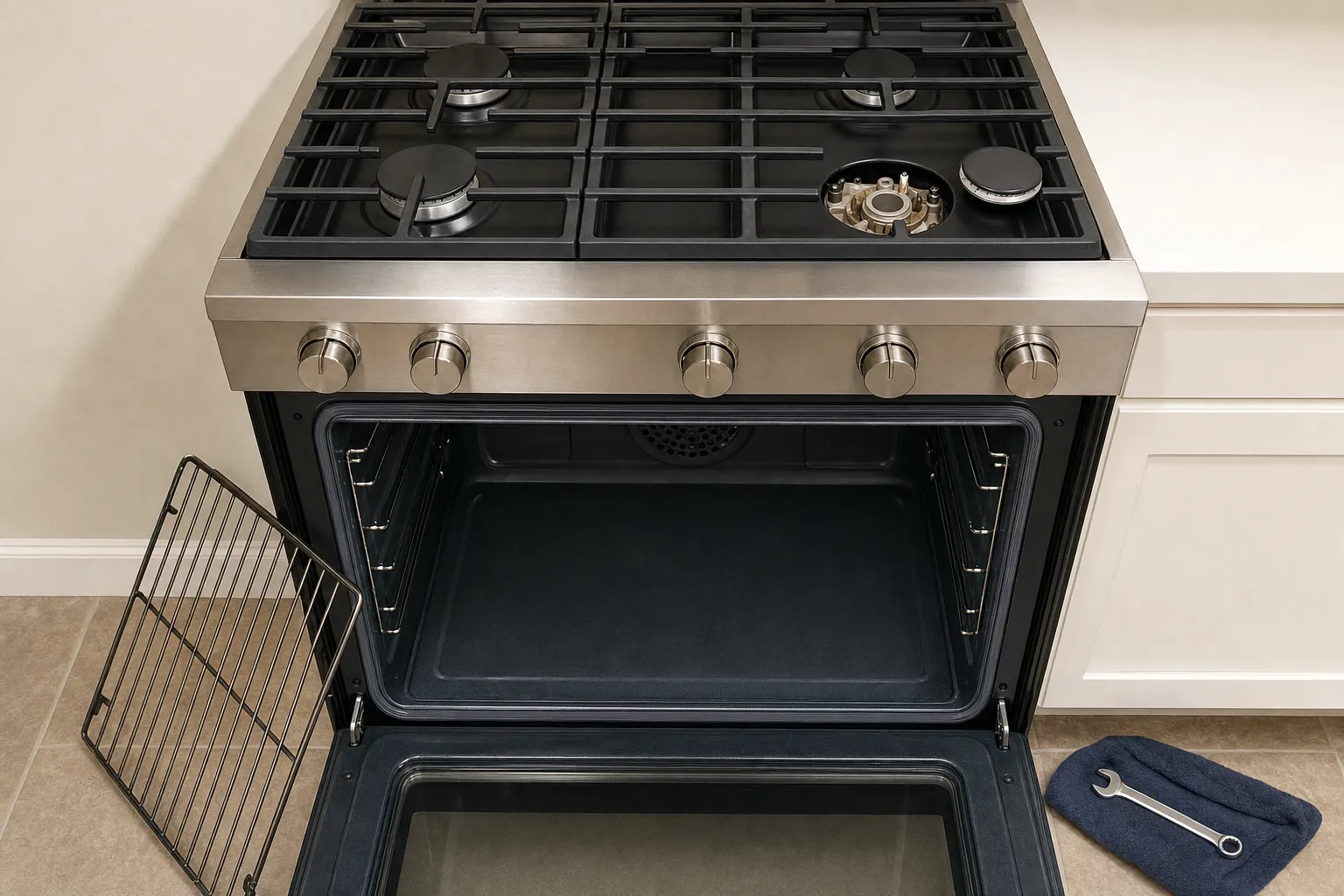
Blue on every burner but one, and that one lazy, yellow and blackening the pans. Usually a cap or dirty ports; now and then the gas and air mix.
A cap off true, or ports that need clearing
Row one is usually the whole story. A clean-up that leaves the cap a few millimetres off its seat, or water lying under it, bends the flame and starves part of the ring of air. Viking’s own care instructions link a clean, level cap to even flames and proper ignition, and putting it right costs nothing.
The second row is the same burner a stage further on. Burnt-on spill shuts some of the ports, the gas crowds through the ones still open, and the flame there turns tall, soft and yellow. A straight pin clears them. Enlarging a port to hurry the job upsets that burner for good.
The third row is where owner checks run out. Viking’s troubleshooting table lists three causes when a flame comes out large, distorted or yellow: clogged ports, the wrong type of gas, and air shutters out of adjustment. With the ports already clear, one burner on its own points at its own shutter or orifice. Neither has a published band, so both are priced after the diagnosis.
The wrong-gas cause shows differently. It turns every burner yellow together, not one. Around the South Sound some houses cook on a gas main and others on a propane tank, and a Viking moved from one kind of house to the other keeps the set-up it left with. If the whole cooktop changed colour after a move, say so when you call.
Why bother at all? A blue flame burns its gas completely; a yellow one does not, and the soot on the pans is the evidence.
Owner checks, in this order
- Let the burner go fully cold, lift the grate and pull the cap straight up. Look under it and round the ring of ports for crust.
- Wash the cap in warm soapy water with a soft cloth, then dry it and the burner completely before anything goes back.
- Push a straight pin into any port that is closed. Do not widen the hole, and leave toothpicks out of it; Viking rules them out.
- Seat the cap so it sits level without rocking, light the burner, and watch the whole ring before you cook on it.
- Stop there. Anything past these checks means panels off or gas and wiring, and that is the $89 visit from Viking Repair Tacoma: (206) 472-1140.
Asked about this one
Is a yellow flame dangerous, or only messy?
It is gas burning short of air, which is what leaves the black film on your pans, and it is worth putting right rather than cooking round. Keep the kitchen ventilated while you use that burner. A strong smell of gas is another matter entirely: leave the house and call the gas company or 911 once outside.
Can the flame be tuned without replacing anything?
Often, yes. Each burner's flame is set by its orifice and an air shutter, and Viking's service literature has the shutter opened until the yellow tips go. That adjustment lives under the cooktop, so it is not an owner job. Viking Repair Tacoma checks the setting, and the gas it suits, on the $89 visit: (206) 472-1140.