Viking Refrigerator MAX REF Mode, Explained
| This guide | Fault Guides |
|---|---|
| Appliance | Viking Refrigerator Repair |
| Written by | Hollis Yamada |
| Role | Service technician — refrigeration and cooking |
| In the trade | 21 years in the trade |
| Reading time | 5 min |
| If it needs a visit | $89, credited to the repair |
On a Viking 5 Series built-in, MAX REF holds the fridge at its coldest setting for four hours, then reverts by itself. When to use it, and when not to.
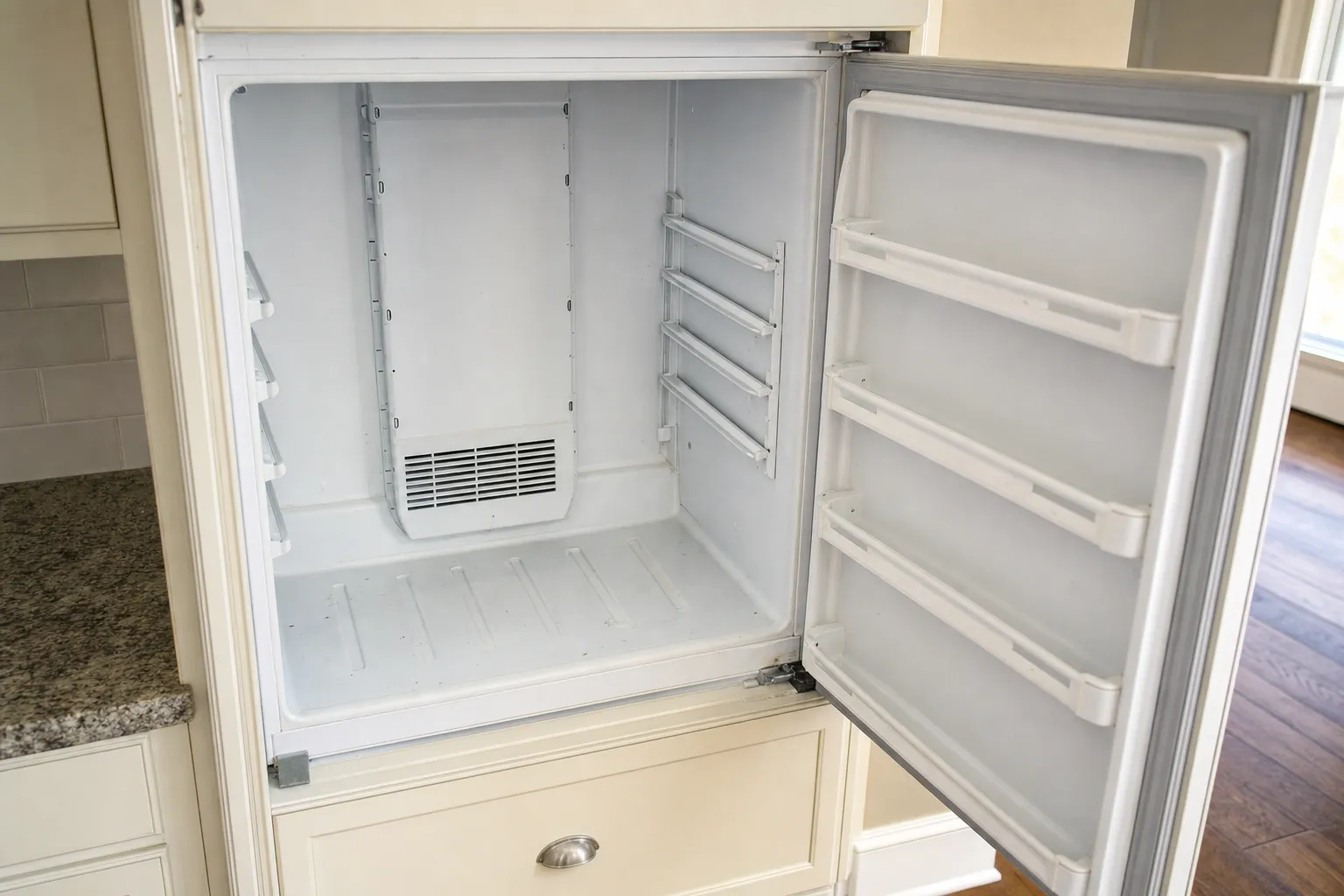
MAX REF is a short cold boost, not a new temperature setting. On a Viking 5 Series built-in, pressing it drives the fresh-food compartment to its coldest setting for four hours, and then the refrigerator slips back to whatever temperature you had chosen, with no second press needed. Use it shortly before you unload a big grocery run, or right after the door stood open while you scrubbed shelves, and the cabinet pulls back down faster. It cannot rescue a refrigerator that has run warm for days; that is a fault, and the boost only masks it for an afternoon.
What the three boost buttons do
Viking gives its 5 Series built-ins three separate boosts, and they sit close together on the panel, so they are easy to mix up:
| Button | What it does | How long it lasts |
|---|---|---|
| MAX REF | Holds the refrigerator side at its coldest setting | 4 hours |
| MAX FRZ | Holds the freezer at its coldest setting | 6 hours |
| FAST COOL | Runs the compressor at high speed | 2 hours |
Each one ends on its own timer, and that is deliberate: a fridge parked at its coldest point all week would ruin lettuce and waste power. The integrated FDREIC all-refrigerator column offers the same idea under the name Max Refrigerator, next to Vacation and Sabbath modes, so the exact wording on your panel depends on which Viking line is in your kitchen.
The 5 Series runs on a single variable-speed compressor with the ProChill system, while the 7 Series uses two, letting the fresh-food and freezer sides work independently. Either way, if you pressed FAST COOL, a louder and steadier compressor hum for the next 2 hours is expected and is not a warning sign.
Good and bad moments to press MAX REF
Times the boost earns its keep:
- An hour or so before a week of groceries or a cooler of party food goes in.
- After a deep clean, when the door was open for a long stretch.
- After a busy holiday, when the door opened every few minutes.
- Once the power comes back after an outage (more on the alarms below).
Times it does nothing useful:
- Right after installation. Out of the box a 5 Series is set to 38°F for fresh food with the freezer at 0°F, and it needs a full 24 hours after plug-in to settle. Allow that same day after any change to the setting before judging it.
- As a daily habit. If the cabinet only feels cold while a boost is running, the boost is covering for a problem.
The everyday settings to come back to
Once the boost ends, the number that matters is your normal set point. The 7 Series integrated all-refrigerators and freezers, sold as VRI and VFI, ship at 39°F and 0°F; leave them alone for 24 hours from plug-in before you nudge either side with the REF or FRZ button.
The FDREIC integrated column can be set anywhere from 34°F to 45°F, holds within 1°F of its setting, and keeps its three crisper drawers 2°F to 3°F colder than the main cabinet. That crisper offset is why owners overshoot. Set an FDREIC to 34°F and the drawers end up hovering around freezing, which is hard on leafy greens and soft fruit.
The Department of Energy’s efficiency program recommends 36°F to 40°F for the fresh-food compartment and notes that going under 36°F burns extra electricity with no gain in food storage. The factory preset already sits in that window.
Screens that look like faults but are not
Several Viking displays look alarming while working as designed:
- SHOW on a 5 Series. Showroom mode is active, so the panel and lamps work while the cooling stays off. Hold ACTIVATE CONTROLS, then press HIGHER and ALARM OFF together until you hear three beeps.
- A 7 Series with no cooling and no codes. Pressing VAC with ALARM for 3 seconds is the toggle for showroom mode. While it is active only the interior lights keep working, temperature regulation is shut off and fault codes stay hidden, so rule it out first.
- An integrated FDREIC that glows but stays warm. A unit left in Demo Mode after showroom use displays temperatures that are not real. Viking’s advice is to contact the store or dealer you bought it from to have it turned off.
- SAB lit on the panel. That is Sabbath mode, which changes how the controls and lights behave on purpose.
- DOOR OPEN, HIGH TEMP or a flashing POWER light. DOOR OPEN blinks after a door has been open more than three minutes, HIGH TEMP glows once a compartment has been too warm for two hours, and a flashing POWER light records a power loss. Press ALARM OFF to clear them.
Fall windstorms knock out power around Tacoma often enough that a flashing POWER light and a HIGH TEMP warning after the lights return are a familiar pair. Clear the alarms, check whether perishables stayed cold, then run MAX REF to bring the cabinet back down sooner.
When the boost does not bring the cold back
If a full four-hour MAX REF cycle finishes and the cabinet is still warm, stop pressing buttons. A fridge that cannot reach its setting with a boost running usually has trouble in its airflow or cooling: an evaporator fan that has stopped, a defrost system that let frost smother the coil, a control fault or, less often, a sealed-system failure. Ice production tends to stall at the same time, because the ice maker only works when the freezer is cold enough.
We serve homes in the North End, Proctor District, Stadium District and Northeast Tacoma. Our call-out fee is $89; it buys the drive to your house plus a full diagnosis, and every dollar of it comes off the repair bill when you approve the work. Typical ranges, with a firm quote after diagnosis: a refrigeration fan or defrost system repair runs $270–$650, a control board or touch panel $430–$630, and compressor or sealed-system work $1,340–$3,330. You can read more about Viking refrigerator repair in Tacoma, see the full map of neighborhoods we cover, or call (206) 472-1140.
Asked after reading this
How long does MAX REF run on a Viking refrigerator?
On a Viking 5 Series built-in, MAX REF runs for four hours and then hands control back to your normal setting without another button press. Its freezer twin, MAX FRZ, lasts 6 hours, and FAST COOL pushes the compressor at high speed for 2 hours.
Should I leave MAX REF switched on all the time?
No, it is a short boost rather than a setting to live with, which is exactly why it turns itself off. If you are pressing it every day just to keep milk cold, something is wrong, such as a fan that has quit, frost building on the coil or a door that no longer seals.
Why does my Viking fridge light up but not get cold?
A Viking that lights up, shows a temperature and stays warm is often sitting in a showroom or demo setting rather than broken. On a 5 Series built-in the panel reads SHOW; to leave it, hold ACTIVATE CONTROLS and press HIGHER and ALARM OFF together until three beeps sound.
What temperature should a Viking refrigerator be set to?
Start with the factory preset: 38°F on 5 Series built-ins and 39°F on 7 Series integrated models, with the freezer at 0°F. Federal energy guidance puts the useful fresh-food range at 36°F to 40°F and says going below 36°F costs power without keeping food any better.