Griddle Hot at One End, Cold at the Other
| Reading | Likely cause | Owner check | Price band |
|---|---|---|---|
| One end scorches from the start; the far end barely warms | Ports closed along part of the burner, so the flame stops short | Empty the grease trough; leave the plate where it is | Quoted after the diagnosis |
| The whole plate slow to heat, the cold end worst | A weak flame the full length: a part-blocked orifice or a worn burner | Time how long the heating light stays on | $180–$440Igniter or burner assembly |
| Heating light goes out while one end is still cool | The griddle thermostat switching off too early | Note the setting and when the light went out | Quoted after the diagnosis |
| Light stays on, yet the plate is cooling | No flame under the plate: the burner is not lighting or holding | Griddle off; if you smell gas, leave | $180–$440Igniter or burner assembly |
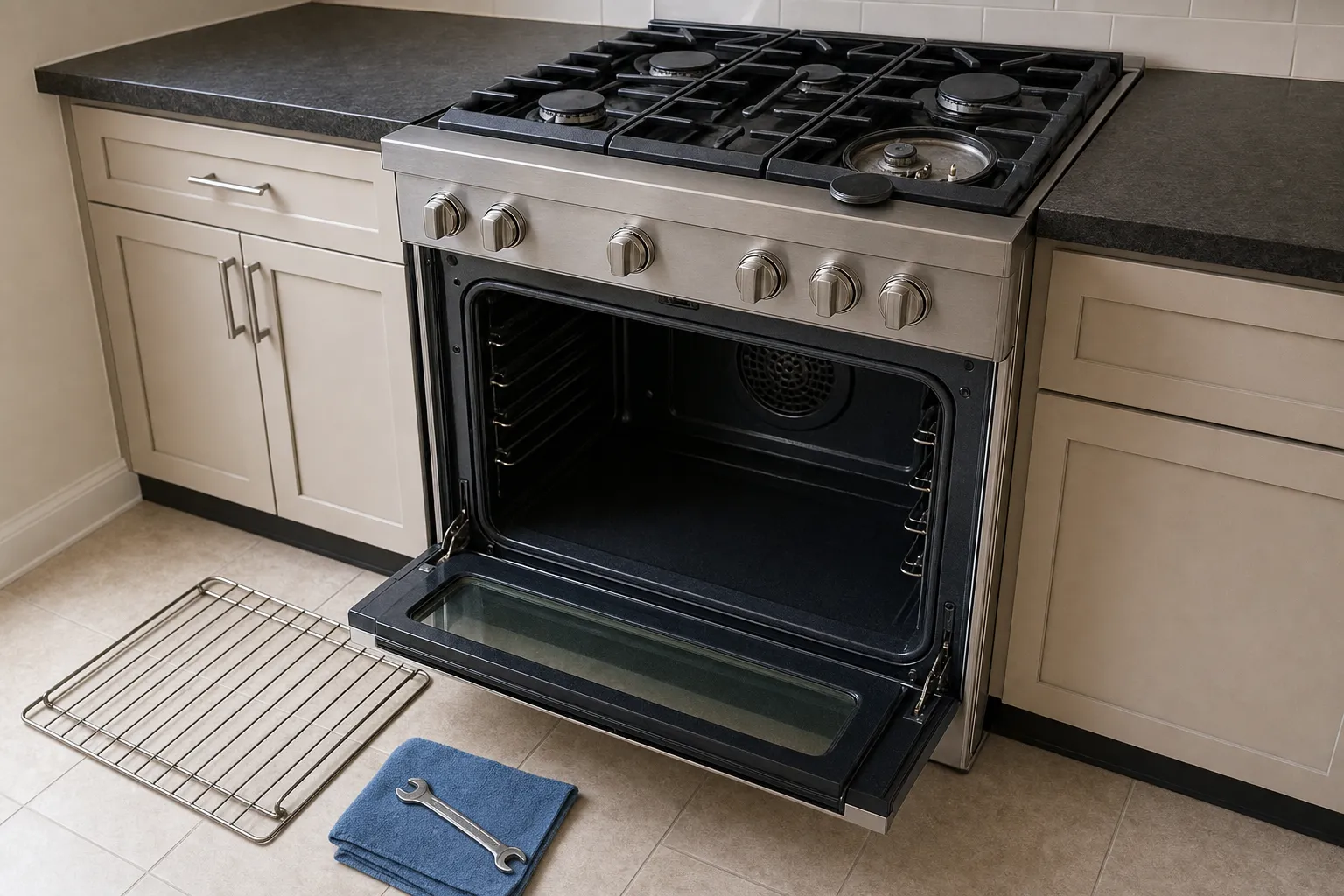
The plate is scorching at one end and barely warm at the other. Usually the burner under it is lit only part of the way; sometimes the control.
One long burner, and where its heat stops
The top row is the usual answer. A Viking griddle is heated by a long tube burner running under the plate, and spill or grease that works its way down can close the ports along one stretch of it. The flame then burns only part of the way across, and the end beyond the gap never catches up, however long you wait. Clearing those ports means lifting the plate, which is technician work, and because nothing is replaced it is priced after the diagnosis.
Row two is the same burner weak along its whole length, so the plate is slow everywhere and worst at the far end. A worn burner that has to be replaced falls in the igniter and burner band.
The last two rows lean on the heating light. On current Viking griddles it glows while the thermostat is calling for heat and goes out once the plate reaches the setting. A light that goes out with one end still cool points at the thermostat, which has no published band here. A light that stays on while the plate cools means the thermostat is asking and no flame is answering: the burner has not lit, or will not stay lit, and its igniter is the first suspect.
Only the wider Vikings carry a griddle, so these calls come from the bigger South Sound kitchens rather than compact city ones.
Owner checks, in this order
- Pull the grease trough at the front toward you, lift it out, empty it and slide it back in.
- Set a middle temperature and watch the heating light (a lit ring behind the knob on some models): on while the plate warms, out at the setting.
- When the light goes out, wipe a thin film of oil across the plate and see where it shimmers.
- Leave the plate in place: the burner and its igniter sit underneath, and lifting it belongs to the visit.
- Stop there. Anything past these checks means panels off or gas and wiring, and that is the $89 visit from Viking Repair Tacoma: (206) 472-1140.
Asked about this one
Is one end of a Viking griddle meant to run hotter?
No. Viking describes the griddle's electronic thermostat as holding an even temperature across the plate once it is set. A cold end is a fault to trace, not a habit of the appliance to cook round. Tell us the setting and how long the light stayed on. Viking Repair Tacoma takes it from there on (206) 472-1140.
Which Viking ranges have a griddle in the first place?
The wider ones. In Viking's guide to its 5 Series gas ranges the griddle models are 36 inches wide and up, and the 30-inch model has four burners only. Older and other series have their own layouts, so give us the model number when you call if you have it to hand.