Fresh Food at 50°F, Freezer Still Frozen
| Reading | Likely cause | Owner check | Price band |
|---|---|---|---|
| Fresh side warm; white frost on the rear panel or round the vent | Defrost has failed and ice is choking the coil and the air path | Look at the back wall and vent for frost; leave it in place | $270–$650Refrigeration fan or defrost system |
| Warm, no frost, and the usual hush of moving air has gone | The fan that drives cold air through the cabinet has stopped | With the kitchen quiet, listen at the closed door for the fan | $270–$650Refrigeration fan or defrost system |
| Warmest by the door, fine at the back; door edge not pulling in | Gasket folded or torn, or the door knocked out of square | Shut the door on a sheet of paper in a few places and tug | Quoted after the diagnosis |
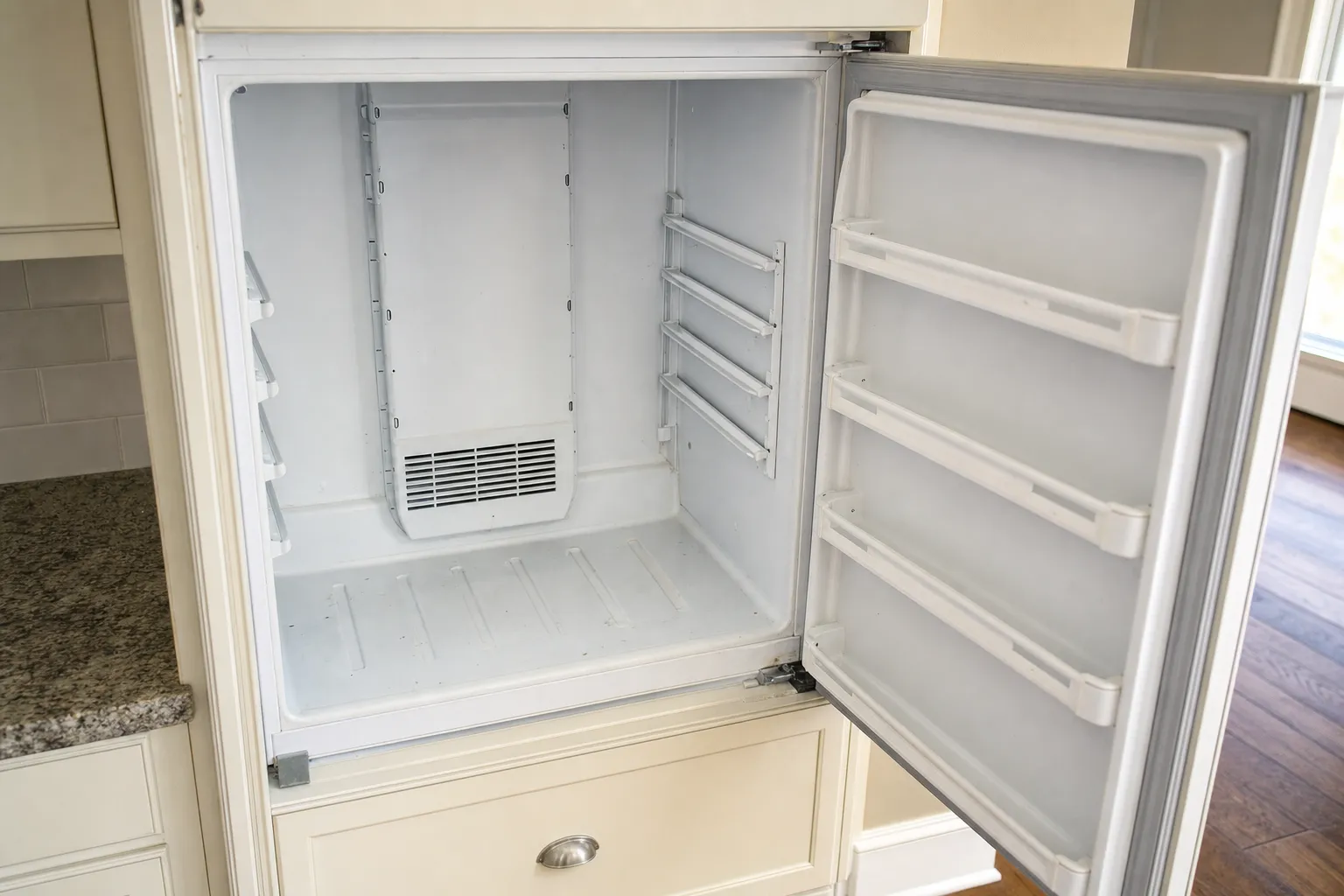
The freezer is rock hard, the fresh-food side has crept up and the milk is on the turn. Usually a fan or the defrost system has stopped moving the cold.
Cold that is made but never arrives
Start with the top line of the table. A built-in melts the frost off its cooling coil every so often with a defrost heater. When that cycle stops, frost builds until it seals the coil and air can no longer pass. The fresh-food side shows it first while the ice cream stays hard. Frost packed round the vent or across the rear panel gives it away; the repair sits in the refrigeration fan or defrost band.
The second row looks the same from the front, minus the frost. The coil is cold, but the fan meant to push air over it has seized or lost power. Viking lists that fan’s rush of air among a built-in’s normal sounds, so silence is worth mentioning. Same band.
Row three is the mildest kind of warm. A door stopping just short of its seal lets kitchen air in along one edge, and the shelves nearest the door suffer first. A rolled gasket, a bottle in the way or a door out of square are the usual suspects; none carries a published band.
Viking ships its 5 Series built-ins set to 38°F in the fresh-food section and 0°F in the freezer, so a steady 50°F in that glass of water is a fault, not a setting. Behind a wood panel in a Stadium District kitchen or a downtown condo, the milk usually warns you before any display does.
Owner checks, in this order
- Look at the fresh-food set temperature on the controls. If it has been nudged up, put it back and allow the full 24 hours Viking asks for after any change.
- Stand a thermometer in a glass of water on a middle shelf overnight; the water reads steadier than the display does.
- Move anything pressed against the vent at the back and leave gaps between packages; Viking's guide warns that a crammed cabinet blocks the air.
- Stop there. Anything past these checks means panels off or gas and wiring, and that is the $89 visit from Viking Repair Tacoma: (206) 472-1140.
Asked about this one
Is the food still safe if the fresh side reads 50°F?
The FDA's line is 40°F or below for a refrigerator and 0°F for a freezer, so 50°F is on the wrong side of it. Move milk, meat and leftovers to a cooler or the freezer while you wait, and judge them by the FDA's guidance rather than by smell. A hard freezer does nothing for the other side.
Why is the freezer still frozen if something has failed?
Because refrigeration is still happening; the cold is simply not arriving where it should. Many built-ins make it at one coil and fan it across, while some Viking models run a separate system for each side. Viking Repair Tacoma works out which applies to yours at the $89 visit. Call (206) 472-1140 to book it.