Convection Fan Rattles or Has Stopped
| Reading | Likely cause | Owner check | Price band |
|---|---|---|---|
| Light tick or scrape each time the blade comes round | A rack, tray or foil touching the cover, or the cover itself loose | Cold oven: pull the racks forward and clear the back wall | Quoted after the diagnosis |
| Growl or hum that builds as the oven heats | Motor bearings wearing out | Note whether it is quiet from cold and louder once hot | Quoted after the diagnosis |
| Silent on every convection setting while plain bake still heats | Open motor windings, or the selector contacts that switch the fan | Make sure a convection setting is chosen, not plain bake | Quoted after the diagnosis |
| Built-in electric oven: fan pauses, then turns again | Normal on TruConvec, which runs the fan slowly and reverses it | Nothing to do; compare the sound on another convection setting | Quoted after the diagnosis |
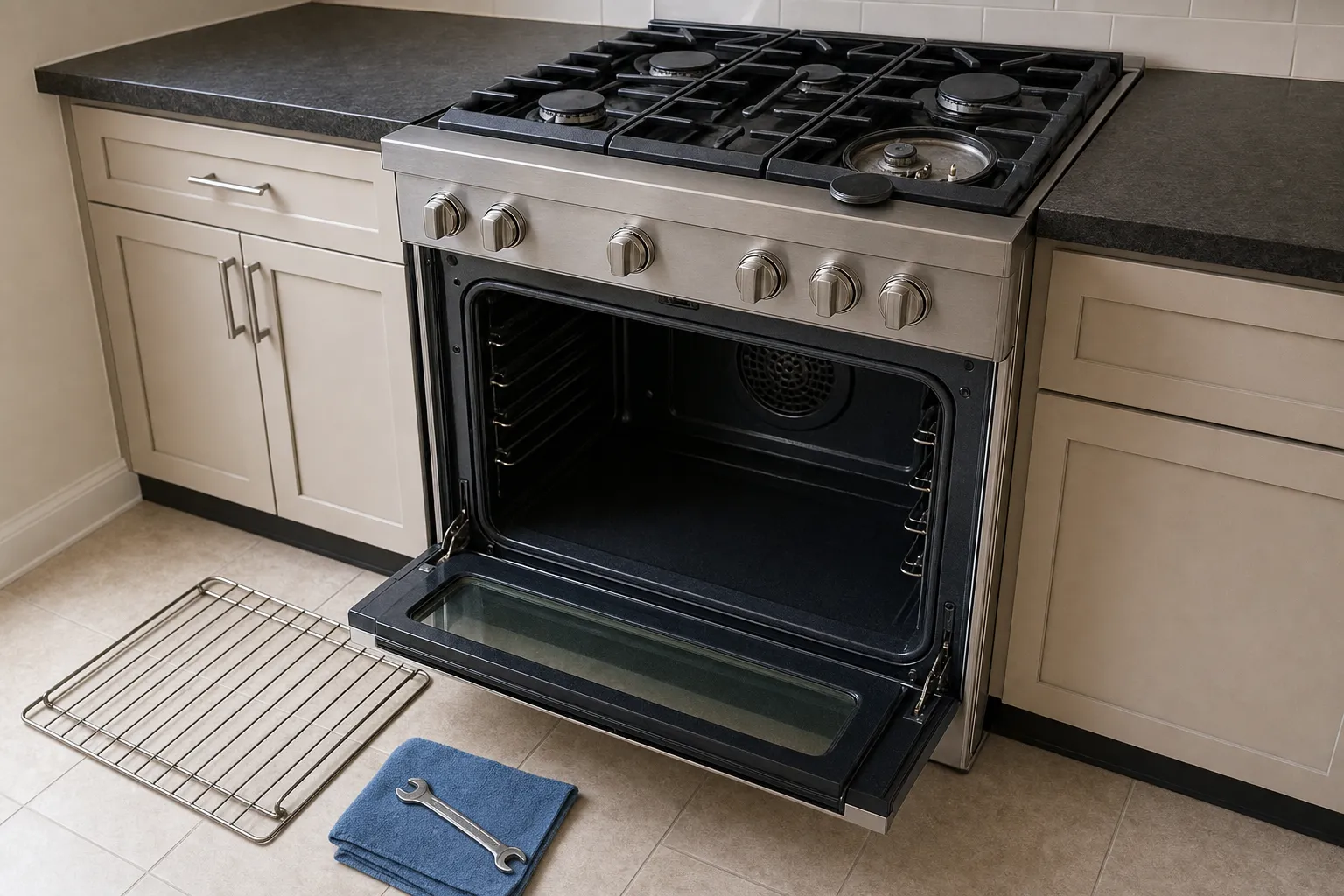
A tick, a growl or silence from the fan behind the round cover at the back. Something touching it, a motor wearing out, or a motor that has quit.
A tick, a rattle, or nothing at all
A tick is the easiest of these to cause and to cure. A rack pushed hard against the back wall, or foil on a low rack, brushes the cover or the blade behind it and ticks on every turn; a loose cover buzzes much the same way. Clearing the back wall ends most of these without a part.
The second row is the motor itself. Worn bearings usually start as a hum that grows as the oven heats and fades as it cools, and a tiring motor often slows before it stops.
In the third row the fan has quit. Viking’s troubleshooting table for its gas self-clean ranges gives two causes for convection that fails while bake works: open contacts in the selector switch, or open windings in the fan motor. For its built-in electric ovens the list adds the convection element, relays and the control board.
The bottom row is not a fault. On Viking’s built-in electric ovens the TruConvec setting keeps the fan on low speed and changes its direction, so a pause and a restart is the oven doing its job. In an all-electric Tacoma kitchen with a built-in Viking, check which setting was on before assuming the fan has failed.
Fan motors, elements behind the cover and selector switches have no published band and are priced after the diagnosis.
Owner checks, in this order
- With the oven cold, slide the racks forward and lift out any tray, pan or foil that sits against the round cover on the back wall.
- Choose a convection setting rather than plain bake. On Viking's knob-controlled gas ranges the fan runs only in the convection positions.
- Note when the noise starts, cold or hot, and which setting was on. Those two details usually narrow it to one part.
- Leave the cover screwed on. Reaching the fan means the power off and the oven door off, which puts it on the technician's side of the line.
- Stop there. Anything past these checks means panels off or gas and wiring, and that is the $89 visit from Viking Repair Tacoma: (206) 472-1140.
Asked about this one
Is the oven still usable with the convection fan dead?
Yes, on plain bake, which on Viking's knob-controlled ranges does not use the fan. Expect longer times and patchier browning on convection recipes. Do not keep switching a stalled fan on to see whether it frees itself; a jammed motor gains nothing from it. Viking Repair Tacoma takes the call on (206) 472-1140.
There is a fan running after the oven is switched off. Is that this fault?
Usually not. Viking's gas self-clean ranges carry a separate cooling fan that keeps running for several minutes after a clean, until the oven is down to a safe temperature. A fan that never stops once the oven is cold is worth reporting, but it is a different part from the one behind the round cover.